

The Ancient Gate of Isis in Aswan A Hidden Temple, Sacred History & Visitor Guide 2026/2027
Discover a hidden treasure in the heart of Aswan.
When travelers think of the goddess Isis in Aswan, they usually imagine the magnificent Temple of Philae, surrounded by the waters of the Nile.
However, Aswan has another remarkable archaeological treasure associated with this powerful ancient Egyptian goddess.
Hidden within the historic city is the Temple of Isis in Aswan, an ancient sanctuary distinguished by its decorated entrance, surviving stone walls, religious reliefs, and fascinating history.
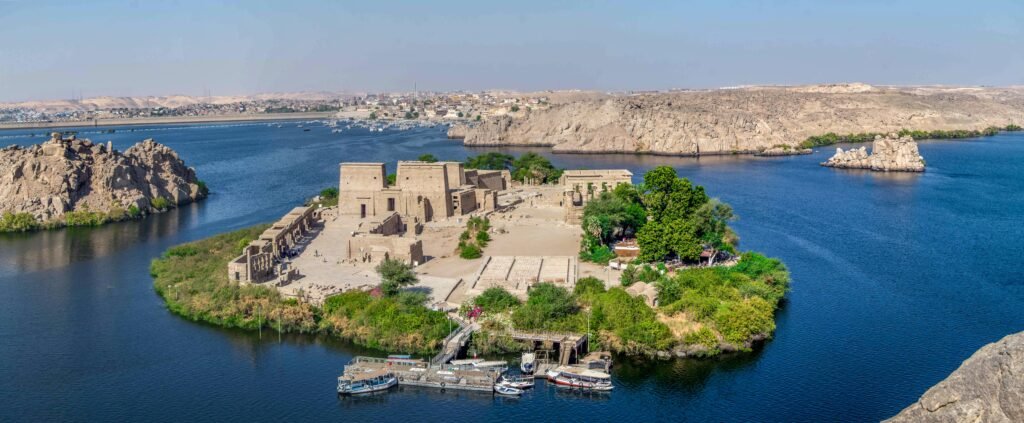
Unlike the famous Philae Temple, which was relocated to Agilkia Island during the international campaign to save Nubian monuments, this smaller sanctuary is associated with the ancient urban landscape of Aswan.
Its gateway provides an extraordinary introduction to the religious traditions of southern Egypt and the importance of Isis during the Ptolemaic period.
In this guide, Trust Way Travel explores the history of the Ancient Gate of Isis, the temple behind it, its religious significance, and what travelers should know before visiting.
Table of Contents
- Where Is the Ancient Gate of Isis Located?
- What Is the Ancient Gate of Isis?
- The History of the Temple of Isis in Aswan
- Who Was the Goddess Isis?
- Why Was Isis Important in Aswan?
- Architectural Features of the Temple
- The Meaning of the Winged Sun Disk
- Religious Scenes Inside the Temple
- Was the Temple of Isis in Aswan Moved?
- The Temple's Christian History
- Archaeological Discoveries and Conservation
- Temple of Isis in Aswan vs. Philae Temple
- Why Is the Ancient Gate of Isis Worth Discovering?
- Best Time to Explore Ancient Aswan
- Other Historical Attractions to Visit in Aswan
- Discover Aswan with Trust Way Travel
- Frequently Asked Questions
- Explore the Hidden History of Aswan
Where Is the Ancient Gate of Isis Located?
The gateway is part of the Temple of Isis situated within the city of Aswan, near the eastern side of the historic urban area.
This is a different archaeological site from the famous Temple of Philae.
While Philae stands on Agilkia Island and is reached by boat, the smaller Temple of Isis belongs to Aswan's mainland archaeological heritage.
Its location makes it particularly interesting for visitors wishing to explore lesser-known ancient monuments beyond the city's major tourist attractions.
What Is the Ancient Gate of Isis?
The Ancient Gate of Isis refers to the decorated entrance of the Temple of Isis in Aswan.
The entrance is an important architectural feature of the sanctuary and includes religious decorations and hieroglyphic inscriptions.
Above the doorway, visitors can observe the traditional winged sun disk, a symbol commonly associated with divine protection in ancient Egyptian temple architecture.
The entrance leads into the surviving temple structure, where ancient reliefs reveal aspects of religious life in Ptolemaic Egypt.
Rather than being a separate monumental gateway, it should be understood as part of the temple's original architectural arrangement.
The History of the Temple of Isis in Aswan
The surviving sanctuary dates principally to the Ptolemaic period.
Parts of the temple were constructed or decorated during the reigns of Ptolemy III and Ptolemy IV, when Egypt was ruled by the Greek-speaking Ptolemaic dynasty.
Although the rulers had Greek origins, they continued many ancient Egyptian religious and architectural traditions.
Temples were decorated with traditional representations of Egyptian gods and kings performing sacred rituals.
The Temple of Isis in Aswan is an important example of this continuity.
Its surviving reliefs reflect religious traditions that had developed over thousands of years.
Who Was the Goddess Isis?
Isis was one of the most important goddesses in ancient Egyptian religion.
She was associated with motherhood, protection, healing, royal power, and magic.
According to Egyptian mythology, Isis was the wife of Osiris and the mother of Horus.
Her role in restoring Osiris and protecting Horus made her a central figure in Egyptian beliefs about kingship and the afterlife.
During the Ptolemaic and Roman periods, the worship of Isis spread far beyond Egypt.
Temples dedicated to her were established throughout parts of the Mediterranean world.
In Aswan, her worship was connected with the religious traditions of the Nile and the southern frontier of ancient Egypt.
Why Was Isis Important in Aswan?
Aswan occupied a strategic position near the First Cataract of the Nile.
In ancient times, the city was an important center of trade, administration, and cultural exchange between Egypt and regions farther south.
Its religious landscape included the worship of several important deities.
Among them were:
- Isis: Goddess associated with protection, motherhood, and divine kingship.
- Khnum: A creator god closely associated with the Nile and the First Cataract.
- Satet: A goddess associated with the cataract region and the Nile.
- Anuket: A goddess linked with the Nile and its surrounding landscape.
The Temple of Isis contains religious scenes connected with several of these deities, reflecting the complexity of Aswan's ancient religious traditions.
Architectural Features of the Temple
Although the sanctuary is much smaller than the Temple of Philae, it preserves several notable architectural elements.
The Decorated Entrance
The main entrance features religious decorations and the winged sun disk.
The doorway introduces visitors to the sacred space beyond.
The Stone Walls
The temple preserves substantial sections of its enclosing walls, an important reason for its archaeological significance.
The Interior Hall
The entrance leads into an interior space connected with several smaller chambers.
The Sanctuary
The innermost sacred area was associated with religious rituals and divine worship.
Religious Reliefs
The walls contain scenes depicting rulers presenting offerings to Egyptian gods and goddesses.
Together, these elements provide valuable evidence of temple architecture during the Ptolemaic period.
The Meaning of the Winged Sun Disk
One of the most recognizable symbols in ancient Egyptian architecture is the winged sun disk.
It frequently appears above temple entrances and sacred doorways.
The symbol is associated with divine protection and the solar god Horus of Behdet.
Its presence above the gateway emphasizes the religious importance of the entrance.
For ancient worshippers, passing through a temple gateway represented movement from the ordinary world toward a sacred environment.
The decorations reinforced this transition.
Religious Scenes Inside the Temple
The Temple of Isis contains reliefs showing rulers presenting offerings to various deities.
Some scenes feature the gods Khnum, Satet, and Anuket.
Other decorations are associated with Isis herself.
These scenes were not simply artistic decorations.
They formed part of the temple's religious program, representing the relationship between the ruler and the divine world.
The inscriptions also provide valuable information about religious practices and royal ideology during the Ptolemaic period.
Was the Temple of Isis in Aswan Moved?
One of the most important distinctions between this temple and the famous Temple of Philae concerns their modern histories.
The principal monuments of Philae were dismantled and reconstructed on Agilkia Island as part of the international rescue campaign organized with UNESCO.
The Temple of Isis in Aswan city was not part of that relocation project.
It is therefore important not to confuse the two sanctuaries when researching Aswan's ancient monuments. Both are connected with Isis, but they have different locations, architectural characteristics, and archaeological histories.
The Temple's Christian History
Like several ancient Egyptian religious buildings, the Temple of Isis experienced changes in use during later periods.
Archaeological evidence indicates that it was converted into a Christian place of worship, probably dedicated to the Virgin Mary.
Coptic inscriptions discovered at the site provide evidence of this later phase.
This history illustrates how ancient religious buildings could acquire new functions as beliefs and communities changed.
The temple therefore offers insights into both ancient Egyptian religion and the Christian history of Aswan.
Archaeological Discoveries and Conservation
The Temple of Isis was documented in the nineteenth century and has been the subject of subsequent archaeological research and conservation.
Its relatively well-preserved structure makes it an important monument for studying the ancient city.
Researchers have examined architectural remains, inscriptions, and evidence of later occupation around the sanctuary.
Conservation work has also contributed to understanding the temple's decoration and construction.
The site demonstrates how archaeological research can reveal multiple historical periods within a single monument.
Temple of Isis in Aswan vs. Philae Temple
| Feature | Temple of Isis in Aswan | Temple of Philae |
|---|---|---|
| Location | Aswan city | Agilkia Island |
| Main association | Worship of Isis and regional deities | Major sanctuary of Isis |
| Historical period | Principally Ptolemaic | Predominantly Ptolemaic and Roman |
| Scale | Small sanctuary | Large temple complex |
| Relocated during Nubian rescue campaign | No | Yes |
| Visitor experience | Lesser-known urban archaeological site | Major island attraction |
Both sites offer valuable opportunities to understand the worship of Isis and the religious history of southern Egypt.
Why Is the Ancient Gate of Isis Worth Discovering?
The Temple of Isis is particularly interesting for travelers who want to explore beyond Aswan's most famous monuments.
Its significance lies in several features:
- 1. Its connection with the goddess Isis.
- 2. Its surviving Ptolemaic architecture.
- 3. Its decorated ancient gateway.
- 4. Its religious reliefs and inscriptions.
- 5. Its relationship with the ancient city of Aswan.
- 6. Its evidence of later Christian use.
- 7. Its distinction from the relocated temples of Nubia.
For visitors interested in archaeology, the site adds depth to the story of Aswan.
Best Time to Explore Ancient Aswan
The period from October to March generally offers more comfortable weather for sightseeing in Aswan.
During these months, temperatures are usually milder than in summer.
Early morning can be especially pleasant for exploring outdoor archaeological sites.
Summer temperatures in southern Egypt can be extremely high, so adequate hydration and sun protection are essential.
Before planning a visit to the Temple of Isis, travelers should confirm current public access arrangements and opening conditions.
Other Historical Attractions to Visit in Aswan
Philae Temple
One of Egypt's most beautiful ancient temple complexes, dedicated primarily to Isis and situated on Agilkia Island.
Elephantine Island
An important archaeological area associated with ancient settlements, temples, and the history of the First Cataract.
The Unfinished Obelisk
A remarkable monument that reveals ancient Egyptian stone-working techniques.
Nubian Museum
A museum presenting the history, archaeology, and cultural heritage of Nubia.
Qubbet el-Hawa
An archaeological area containing ancient tombs overlooking the Nile.
The High Dam
A major modern engineering landmark connected with the transformation of the Nile landscape and the rescue of Nubian monuments.
These attractions can be combined in a broader exploration of Aswan, depending on the available itinerary.
Discover Aswan with Trust Way Travel
Aswan is a destination where ancient history, Nubian culture, and the beauty of the Nile come together.
From the world-famous Philae Temple to lesser-known archaeological sites, the city offers experiences for travelers interested in Egypt's rich cultural heritage.
With Trust Way Travel, visitors can explore available Aswan and Nubia travel programs, including cultural excursions, Nile experiences, and visits to major historical attractions.
For specialized archaeological interests, travelers can ask about the possibility of incorporating additional sites into their itinerary, subject to access arrangements.
Frequently Asked Questions
What is the Ancient Gate of Isis in Aswan?
It is the decorated entrance associated with the Temple of Isis in Aswan city, a Ptolemaic sanctuary dedicated to the goddess.
Is it the same as Philae Temple?
No. The Temple of Isis in Aswan city and the Temple of Philae are separate archaeological sites.
Was the Temple of Isis in Aswan relocated?
No. The major Philae monuments were relocated to Agilkia Island, while the smaller Aswan city sanctuary was not part of that relocation.
When was the Temple of Isis built?
Its surviving structure is associated principally with the Ptolemaic period, including the reigns of Ptolemy III and Ptolemy IV.
What can visitors see at the temple?
Notable features include the decorated gateway, stone walls, interior chambers, and religious reliefs.
Why is Isis important in ancient Egyptian mythology?
Isis was associated with motherhood, protection, magic, and divine kingship, and was the mother of Horus.
Can the Temple of Isis be visited?
Visitors should check current access arrangements with the relevant archaeological authorities or their tour organizer before including it in an itinerary.
Can I explore Aswan with Trust Way Travel?
Yes. Trust Way Travel offers travel programs covering Aswan, Nubia, and other destinations in southern Egypt.
Explore the Hidden History of Aswan
The Ancient Gate of Isis and its surrounding sanctuary reveal a fascinating chapter in the history of southern Egypt.
While the great temples of Philae attract worldwide attention, smaller monuments within Aswan city preserve equally valuable evidence of ancient religious life.
From Ptolemaic reliefs to later Christian inscriptions, the Temple of Isis reflects centuries of cultural and religious transformation.
Discover the wonders of Aswan and explore Egypt's remarkable heritage with Trust Way Travel.
Official website: traveltrustway.com
Trust Way Travel – Your Way To Luxury