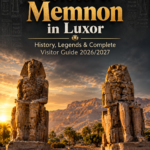


Colossi of Memnon in Luxor History, Legends & Complete Visitor Guide 2026/2027
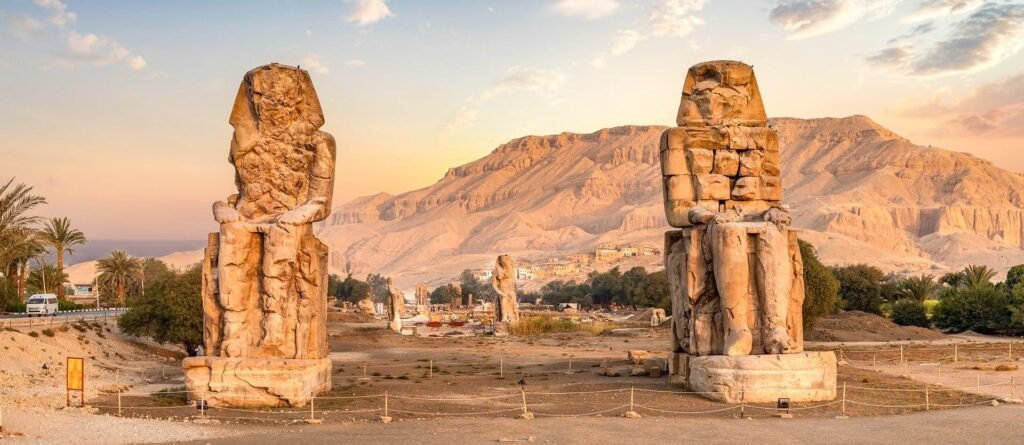
Standing majestically against the dramatic landscape of Luxor’s West Bank, the Colossi of Memnon are among the most recognizable monuments of ancient Egypt.
These two enormous stone statues have watched over the Theban landscape for more than 3,000 years, surviving earthquakes, floods, and centuries of historical change.
Originally created to guard the entrance to the magnificent mortuary temple of Pharaoh Amenhotep III, the statues are now one of the most popular stops on a sightseeing tour of Luxor.
But the Colossi of Memnon are much more than impressive ancient sculptures. They are connected to fascinating stories about Egyptian kings, Greek mythology, mysterious sounds, and one of the largest temple complexes ever constructed in ancient Egypt.
In this guide, Trust Way Travel takes you through the history, architecture, legends, and essential travel information you need to discover the Colossi of Memnon during your next journey to Luxor.
Table of Contents
- Where Are the Colossi of Memnon Located?
- What Are the Colossi of Memnon?
- Who Was Pharaoh Amenhotep III?
- Why Are They Called the Colossi of Memnon?
- The Mystery of the Singing Colossus
- The Lost Mortuary Temple of Amenhotep III
- Architecture and Design of the Colossi
- What Do the Smaller Figures Represent?
- Why Are the Colossi Facing East?
- Are the Colossi of Memnon Worth Visiting?
- Best Time to Visit the Colossi of Memnon
- How Long Should You Spend at the Colossi?
- Best Places to Visit Near the Colossi of Memnon
- Colossi of Memnon vs. Abu Simbel
- Visiting the Colossi of Memnon with Trust Way Travel
- Frequently Asked Questions About the Colossi of Memnon
1. Where Are the Colossi of Memnon Located?
The Colossi of Memnon are located on the West Bank of the Nile in Luxor, Egypt.
They stand near the modern village of Kom el-Hetan, in the area once occupied by the mortuary temple of Amenhotep III.
The site belongs to the wider archaeological landscape of ancient Thebes, which is recognized as a UNESCO World Heritage Site.
The statues are conveniently located along routes connecting several important West Bank attractions, including:
- Valley of the Kings
- Temple of Hatshepsut
- Valley of the Queens
- Medinet Habu Temple
- Ramesseum Temple
Because of their location, the Colossi of Memnon are commonly included in guided tours of Luxor’s West Bank.
2. What Are the Colossi of Memnon?
The Colossi of Memnon are two monumental seated statues representing Pharaoh Amenhotep III, one of the most powerful rulers of Egypt’s Eighteenth Dynasty.
Each statue originally stood approximately 18 meters tall, although their current appearance reflects centuries of damage and restoration.
The statues depict the pharaoh seated on a throne, with his hands resting on his knees and his gaze directed eastward toward the Nile.
Smaller figures carved beside his legs represent important women from the royal family, including Queen Tiye.
The statues once stood at the entrance to Amenhotep III’s enormous mortuary temple, serving as monumental representations of royal power.
Today, they remain among the most impressive surviving examples of colossal royal sculpture in Egypt.
3. Who Was Pharaoh Amenhotep III?
Amenhotep III ruled Egypt during the Eighteenth Dynasty, in the fourteenth century BCE.
His reign is generally associated with political stability, wealth, diplomacy, and remarkable artistic achievements.
Under his rule, Egypt experienced extensive construction activity, including temples, statues, palaces, and ceremonial monuments.
Amenhotep III commissioned major projects in Thebes, particularly on the West Bank.
His mortuary temple was among the largest religious complexes of its time.
Although much of the original temple disappeared over the centuries, the Colossi of Memnon continue to represent the extraordinary scale of his building ambitions.
4. Why Are They Called the Colossi of Memnon?
The name “Colossi of Memnon” originated during the Greco-Roman period.
Ancient Greek visitors associated the statues with Memnon, a legendary Ethiopian king who appeared in Greek mythology and was said to have fought in the Trojan War.
According to the legend, Memnon was the son of Eos, the goddess of dawn.
This association became particularly important because one of the statues reportedly produced mysterious sounds around sunrise.
Greek and Roman travelers interpreted these sounds as Memnon greeting his mother.
However, the statues actually represent Amenhotep III, not the mythical Memnon.
The ancient name survived, and the monuments are still internationally known as the Colossi of Memnon.
5. The Mystery of the Singing Colossus
One of the most fascinating stories connected to the Colossi of Memnon is the legend of the “singing statue.”
After an earthquake damaged the northern statue in 27 BCE, visitors began reporting unusual sounds coming from the monument around sunrise.
Ancient travelers described the sound in different ways, sometimes comparing it to a musical note or a ringing noise.
The phenomenon attracted visitors from across the Roman Empire.
Some travelers even left inscriptions recording their experiences.
What Caused the Singing Sound?
Researchers have suggested that changes in temperature and moisture within the damaged stone may have produced the sounds.
As the morning sun warmed the monument, physical changes in the fractured stone could have created vibrations or audible noises.
This remains a scientific explanation rather than a conclusively demonstrated cause.
Why Did the Statue Stop Singing?
During the Roman period, restoration work was carried out on the damaged statue, traditionally associated with the reign of Emperor Septimius Severus.
Historical accounts suggest that the sounds ceased after the repairs.
Today, the singing statue survives as one of the most intriguing legends associated with ancient Egyptian monuments.
6. The Lost Mortuary Temple of Amenhotep III
The Colossi of Memnon originally formed part of an enormous mortuary temple dedicated to Amenhotep III.
The complex was designed for royal religious ceremonies and the continuation of the pharaoh’s funerary cult.
Its original layout included monumental gateways, courtyards, columns, statues, and ceremonial spaces.
The temple once occupied an extensive area on Luxor’s West Bank.
However, much of the structure was damaged over time by natural processes, stone reuse, and changing environmental conditions.
The two colossal statues remained standing even as large portions of the surrounding temple disappeared.
Archaeological Discoveries at Kom el-Hetan
Modern archaeological projects have uncovered important remains of the original temple.
These discoveries include additional statues, architectural elements, and evidence of the complex’s original scale.
The excavations have helped researchers reconstruct the history of Amenhotep III’s temple and better understand its religious and architectural importance.
The site continues to offer valuable insights into royal building projects during the New Kingdom.
7. Architecture and Design of the Colossi
The Colossi of Memnon are remarkable examples of ancient Egyptian engineering.
Each statue was carved from massive blocks of quartzite sandstone.
Transporting and positioning these enormous stone sculptures required advanced planning, organization, and technical expertise.
The seated pose follows a traditional Egyptian royal artistic style.
The pharaoh appears calm, powerful, and eternal, reflecting the ideals of kingship in ancient Egypt.
The statues’ impressive dimensions were intended to communicate the authority and divine associations of the ruler.
Even in their damaged condition, they remain extraordinary achievements of ancient sculpture.
8. What Do the Smaller Figures Represent?
Visitors looking closely at the statues may notice smaller carved figures beside the pharaoh’s legs.
These figures include members of the royal family, particularly Queen Tiye.
Their presence reflects the importance of royal relationships and dynastic symbolism.
The contrast between the enormous seated king and the smaller accompanying figures also emphasizes the monumental scale and authority of the pharaoh.
Although some details have been damaged, the surviving carvings provide useful information about royal representation in ancient Egyptian art.
9. Why Are the Colossi Facing East?
The statues face east, toward the Nile and the direction of the rising sun.
In ancient Egyptian religious beliefs, the sun played a central role in ideas of creation, renewal, and rebirth.
The eastern orientation also corresponded with the ceremonial approach to the mortuary temple.
Their placement combined architectural planning with symbolic religious meaning.
10. Are the Colossi of Memnon Worth Visiting?
Absolutely.
The Colossi of Memnon are particularly appealing to travelers interested in Egyptian history, monumental architecture, archaeology, and photography.
Unlike the richly decorated tombs of the Valley of the Kings, this site offers a dramatic outdoor experience.
The enormous statues stand against the landscape of Luxor’s West Bank, creating a memorable setting.
A visit also provides an excellent introduction to the history of Amenhotep III and the ancient Theban necropolis.
Because the statues are located near other major attractions, they fit naturally into a wider West Bank sightseeing itinerary.
11. Best Time to Visit the Colossi of Memnon
The most comfortable season for visiting Luxor is generally October through March, when daytime temperatures are milder than during the summer.
Early morning is particularly attractive for photography because of the softer natural light.
Morning visits can also be more comfortable during warmer months.
In summer, Luxor can experience extremely high temperatures, making sun protection and hydration especially important.
What Should You Bring?
- Comfortable walking shoes
- Drinking water
- Sunglasses
- A sun hat
- Sunscreen
- A camera or smartphone
- Lightweight clothing appropriate for the weather
Always follow local site regulations and instructions during your visit.
12. How Long Should You Spend at the Colossi of Memnon?
For most travelers, approximately 15–30 minutes is enough to admire the statues, take photographs, and hear an introduction to their history.
Travelers with a deeper interest in archaeology may prefer to spend longer exploring the visible remains and learning about the wider mortuary temple.
The exact time depends on the tour itinerary and which parts of the archaeological area are accessible.
13. Best Places to Visit Near the Colossi of Memnon
The West Bank of Luxor contains some of Egypt’s most extraordinary archaeological sites.
1. Valley of the Kings
Explore the royal tombs of the New Kingdom, including the famous tomb of Tutankhamun.
2. Temple of Hatshepsut
Admire the dramatic terraces and monumental architecture of one of Egypt’s most remarkable mortuary temples.
3. Valley of the Queens
Discover the burial place of queens, princes, and princesses, including the celebrated tomb of Queen Nefertari.
4. Medinet Habu Temple
Explore the impressive mortuary temple of Ramesses III, famous for its monumental reliefs.
5. Ramesseum Temple
Visit the mortuary temple of Ramesses II and discover the remains of its colossal statues and ceremonial architecture.
6. Tombs of the Nobles
See fascinating paintings depicting agriculture, crafts, banquets, and daily life in ancient Egypt.
Combining several of these attractions offers a deeper understanding of ancient Thebes.
14. Colossi of Memnon vs. Abu Simbel: What Is the Difference?
Both monuments feature enormous statues of Egyptian pharaohs, but they were created for different purposes.
| Feature | Colossi of Memnon | Abu Simbel |
|---|---|---|
| Location | Luxor | Near Aswan |
| Pharaoh | Amenhotep III | Ramesses II |
| Main feature | Two monumental seated statues | Rock-cut temples with colossal façade statues |
| Historical period | Eighteenth Dynasty | Nineteenth Dynasty |
| Original purpose | Entrance to a mortuary temple | Monumental temple complex |
Both sites demonstrate the remarkable engineering and artistic capabilities of ancient Egyptian civilization.
15. Visiting the Colossi of Memnon with Trust Way Travel
The Colossi of Memnon can be included in a wider exploration of Luxor’s archaeological treasures.
Travelers can combine the site with visits to the Valley of the Kings, the Temple of Hatshepsut, and other West Bank attractions.
For those interested in exploring more of southern Egypt, a longer itinerary can connect Luxor with Esna, Edfu, Kom Ombo, and Aswan.
With Trust Way Travel, you can explore available Luxor and Aswan travel programs and ask about itineraries that include the Colossi of Memnon.
Frequently Asked Questions About the Colossi of Memnon
Where are the Colossi of Memnon located?
They are located on the West Bank of the Nile in Luxor, Egypt, near the remains of Amenhotep III’s mortuary temple.
Who built the Colossi of Memnon?
They were commissioned during the reign of Pharaoh Amenhotep III in the Eighteenth Dynasty.
How tall are the Colossi of Memnon?
The statues originally stood approximately 18 meters tall, although their present appearance reflects ancient damage and repairs.
Why are they called the Colossi of Memnon?
Greek and Roman visitors associated the statues with Memnon, a legendary figure from Greek mythology.
Did the Colossi of Memnon really sing?
Ancient travelers reported hearing sounds from the damaged northern statue around sunrise. The phenomenon may have been caused by physical changes in the fractured stone.
Can tourists visit the Colossi of Memnon?
The monuments are a well-known visitor attraction on Luxor’s West Bank. Access arrangements should be checked before visiting.
How long does a visit take?
Most visitors spend approximately 15–30 minutes at the site.
What is the best time of year to visit?
October through March generally offers more comfortable weather for exploring Luxor.
Are the Colossi of Memnon close to the Valley of the Kings?
Both are located on Luxor’s West Bank and can be visited during the same sightseeing tour.
Can I visit the Colossi of Memnon with Trust Way Travel?
You can contact Trust Way Travel to ask about Luxor itineraries that include the Colossi of Memnon and other archaeological attractions.
Discover the Wonders of Luxor with Trust Way Travel
The Colossi of Memnon are more than ancient statues. They are powerful reminders of the artistic ambition, engineering expertise, and religious traditions of ancient Egypt.
From the mysterious legend of the singing colossus to the remains of Amenhotep III’s enormous mortuary temple, this remarkable site offers a fascinating glimpse into the history of ancient Thebes.
With Trust Way Travel, you can discover Luxor, Esna, Aswan, and some of Egypt’s most spectacular historical destinations through carefully planned travel experiences.
Explore the wonders of ancient Egypt and make your next journey unforgettable with Trust Way Travel.
Official website: traveltrustway.com
Trust Way Travel – Your Way To Luxury